
Trees, Beetles, Climate Change
California Megadrought
|
NEW ESRI StoryMaps: What's On Our Shelves & NWNL Song Library & No Water No Life ESRI |
California Megadrought
Joe Meyer
Branch Chief, Physical Science and Landscape Ecology, Resources Management and Science Division, Yosemite National Park
Gregor Schuurman
National Park Service Ecologist, The Climate Change Response Program
The conversation with Joe was both scintillating and worrisome. Hopefully posting this on our NWNL site will help to bring more awareness of the extra care needed to maintain the integrity of our streams, forests and meadows. It seems National Park scientists are doing their utmost to study and foster resilience of our natural resources in the face of climate change’s many uncertainties.
It seems that the least we can do in return for their service in protecting our environment is to curb our fossil fuel use that increases the effects of climate change events and ravages upon our world’s natural systems.
PATHOGENS, BUGS & DROUGHTS KILL TREES
PROTECTING PINES & FIRS
UNCHARTED TERRITORY NEGATES PREDICTIONS
WE DON/T KNOW
EVEN GREY PINE & INCENCE CEDAR ARE DYING
FOREST LOSS & ITS IMPACTS
MONITORING DATA & UNCERTAINTIES
FOREST, RIVER & MEADOW RESTORED for RESILIENCE
IMPACTS from CLIMATE CHANGE
All images © Alison M Jones. All rights reserved.
Key Quote If you see Ponderosa pines or sugar pines that are 200 years old dying, you think, “Oh, they’ve withstood previous droughts…” But they’re not withstanding this one. – Joe Meyer
JOE MEYER I would like to talk a bit about how trees work. To start, when trees are infected by a pathogen, infected is not quite the right word.
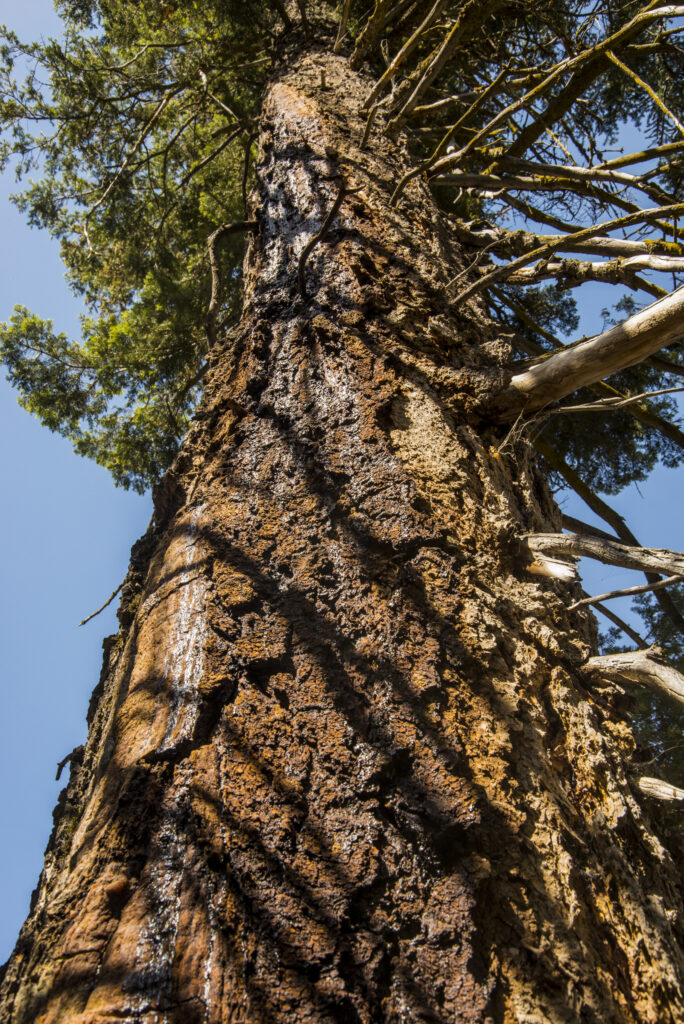
It could be a beetle, bark borer, fungus or other things. One of its first defenses is to send sap to the area and flush out whatever is injuring that tree. The bark beetles that we have are very small, commonly described as about the size of a grain of rice. So, when a beetle drills into a tree here, ff it’s a healthy tree it sends sap to that area. That literally pitches out that bark beetle. But when the trees are already stressed and don’t have water to work with, they can’t do that. The trees are very vulnerable. The bark beetle is a direct cause of the tree’s mortality, but the indirect cause is the drought, which is already weakening the trees and making it hard for them to defend themselves by sending pitch to the beetle’s drilling.
MALE JOURNALIST If you have an unhealthy tree, how do you know it’s being attacked by a beetle if you don’t see the sap coming out? Do you see any signs until the leaves start browning?
JOE MEYER Great question. There’s always sap coming out of trees; they’re always being attacked; and they’re always defending themselves. When you see a lot of sap, or the frass – the refuse the bug throws out of the tree with no sap along with it – that means the tree is not defending itself. Basically, when trees don’t put sap out, you know you’ve got a problem. But we don’t see that in advance.
Trees will go from perfectly green to gray in about a week. Once they go gray, they turn orange a week later. Then they’re brown a week later. They go from apparently healthy to completely dead in three to four weeks.
This drought really is unprecedented. We’ve had droughts in the past, but this drought is different. The California drought that people around here remember, since it happened in our lifetime was only two to three years long. This drought is at least Year 4, maybe longer. We haven’t seen near the amount of mortality we saw in the ‘70s, but the temperature records are about 4 to 5 Fahrenheit degrees hotter in this drought than the last one. That’s enough of a difference.
MALE JOURNALIST They ask how much global climate change has to do with this drought? I don’t know what the metric is, but they say this drought is 15% to 20% more intense. Yet that could be just that temperature gap which leads to 15% to 20% more moisture stress, or something else.
FEMALE JOURNALIST That seems like a very fast reaction.
JOE MEYER Yes, unprecedented – we agree.
FEMALE JOURNALIST What is this, a fungus?
JOE MEYER It’s not really a fungus. We do have weird fungus that will kill trees, but it’s bugs that are doing this. When we do study a tree impacted by animals, we try to figure out what killed the tree and so we’ve got to cut it down. We usually need to peel away the bark at different levels, since the tree could have pathogens just the bottom, but if it loses its ability to send nutrients up and down, the whole tree suffers.
JOE MEYER The bark beetle usually starts at the top and work down. There are several ways to tell the bark beetle, “This tree’s already been infected and so don’t waste your time here.” But we don’t know how well it works.
MALE JOURNALIST Do you do that in some places?
JOE MEYER We have been doing it for sugar pines. The bark beetle only affects the Ponderosa pine. But there’s a different beetle, the mountain pine beetle, that affects the sugar pine. Basically, these bugs are adapted to different trees. Conversely, the trees have adapted to protect themselves against them. The bark beetle is the one that’s having the most dramatic effect on the Ponderosa pine.
Firs do not have a bug that by itself will kill a fir tree. So, when we see a fir tree that’s died, we could have bug infestation, but it’s not enough to kill the tree on its own. It’s probably just water stress on the ground that’s killing the fir.
FEMALE JOURNALIST Are there any vectors that affect white and/or red pines?
JOE MEYER We have red and white firs here, and they do get bugs. But those have not been numerous enough to kill a tree on their own. But a big caveat here – things are different now. So it could be that a bug pathogen that has become vigorous enough to kill a fir on its own. We just don’t know that.
Speaking in forestry terms…, foresters talk about a primary pathogen. They are enough to kill a tree, just a single pathogen alone. There are always bugs attacking trees. There is always fungus attacking trees. But, in the case of firs, we don’t know of a pathogen that by itself will kill a fir tree.
FEMALE JOURNALIST Isn’t that odd?

JOE MEYER Let me tell a story. We have a climatologist we work with. You may know who it is, because I’ve heard him on Insight – Kelly Redmonds. He’s at University of Nevado, Reno. He’s the western regional climatologist, and he comes to Yosemite about once a year to help us with climate issues: hydroclimate, hydrology and climate. A couple of years ago, Kelly shared with us that climatologists – and just about everybody in science – base their predictions on what’s happened in the past. They ask, “When have we seen similar conditions, and what happened when we saw those similar conditions?” But now we are in uncharted territory, and so it’s very hard to predict.
As a matter of fact, Kelly says, “I won’t predict. I will tell you what’s happened in the past El Ninos, but I’m not going to tell you that’s going to happen with this El Nino, or La Nina, or whatever phenomenon or pattern you want to bring up. We are in uncharted territory.”
So, this drought, which is unprecedented, has a much higher tree mortality compared to 1970’s drought. I think back to the last couple of winters that have been bitterly cold through the Midwest and into the deep South. Why? Nobody knows, because things are just different right now. We’re in a chaotic period. I just see that everywhere I look.
MALE JOURNALIST One thing to add to that—I’ll just keep adding—is that we’re in about the 16th month in a row that the global monthly average has been record-setting. You guys have probably seen those headlines. When June was the 14th hottest month, it was a big deal. Last February and March were a big deal, because there was warming in the Arctic that was off of the color spectrum of how that is graphed.
August was the 16th hottest month. El Nino was over, so to the degree El Nino was having that warming impact, it’s now subsided to neutral conditions and perhaps headed to La Nina. Yet we’re still breaking records. That shows the sort of increased rate at which warming is taking place. You may have seen a spiral diagram that represents warming over time. I think Ed Hawkins, a climatologist in the UK, created that diagram. It’s the only one I’ve seen that goes through March, but even in the year leading up to this March, you can see that the line for late 2015 and early 2016 is further away from the previous years than any year has been. The question is, when do we stop breaking records? Yes, we’re outside of our historical ranges of variability.
It’s pretty uncharted, and you get a spectrum of climatologists from those who will just barge right in with, here’s what’s going to happen to some much more cautious people, and they have their own debate in their field about how far to go, and it’s a healthy debate.
JOE MEYER If you’re from California, you might remember there was a guy last winter who was saying, “Godzilla, El Nino is going to be like a conveyer belt of storm after storm after storm.” The prediction going into last winter in California was above average precipitation in Southern California, average precipitation in Central California, and below average precipitation in the Pacific Northwest. Well, the exact opposite happened in the Pacific Northwest where there was flooding. But Central California had average precipitation, and Southern California had far below average precipitation.
My point is, El Nino is not a good predictor. It’s actually a fairly poor predictor. Things are different now, compared to earlier El Nino or La Nina events. So, I thank Kelly Redmond for telling me that story. One thing I will say about good scientists – and I try to be a good scientist – is a good scientist will say, “I don’t know. That research has not been done. We don’t understand.”
People are always asking us, “Well, about the drought?” for instance. “Why?” And we don’t know why because we don’t have controlled experiments in play. We’ve never seen these kinds of conditions. We’re seeing things we’ve never seen before, even though I’ve been here for 21 years, and I’ve worked with fire quite a bit and think I know a lot of these forests.
JOE MEYER In my mind, the two toughest trees we have are gray pine and incense cedar. Well, the very first species that we started to noticeably die in large numbers about five years ago was the gray pine. It’s a lower-elevation chaparral pine. It sticks up out of chaparral fields and is a very tough tree. It started just dying.
Now we’re seeing incense cedar in the park. We have a tough time killing them with fire. That’s why I think they’re such a tough tree. We can kill 90% of the tree – all but a tiny little bit at very top of it, and it’ll live. That’s enough for it to live – even though we’re trying to kill it in the fire, and the incense cedar dies just from moisture stress. Those kinds of things tell me things are changing. We’re in a different system now. That’s why I’m very careful and won’t predict anything. I won’t.
It gets to the point that Gregory was making. When you plan, you try to bring all the information you have to the table. That’s where science is super important – and good, tested information. You test hypotheses. You don’t use anecdotal observation on cedar trees. What we use here is plot-based: here’s what we’ve seen, a change of vegetation based on events on long-term plots.
MALE JOURNALIST I’m with all of that. There’s a climatologist, who is on the more conservative end. He said, “We must be very careful in climatology, because along the way we changed our instruments. There are some challenges with that and with instruments that are better but also different. A lot of care that must be taken in developing a historical record, and then projecting forward.
This climatologist, probably the most conservative I’ve heard, said, “What made me feel sort of comfortable even talking about ongoing trends – and, yes, these things that have changed – is the natural record, so to speak. It’s changing phenology, changes in nature, and different things we’re seeing that tell you about climate change – even if you want to be the most conservative person you could. We’re seeing natural impacts that are unprecedented, and we know that ultimately climate is a driver of many of those changes.
FEMALE JOURNALIST You’ve mentioned “unprecedented” and “die-off” – and what else?
MALE JOURNALIST Well, his assessment included changes in phenology, in green-up, and in key events through the years. I don’t think that’s the be-all or end-all. I think that’s very conservative. But he at least said he felt affirmed or felt more confident, because we now see impacts of a changing climate. He is more comfortable talking about change in climate because of the consequences.
JOE MEYER California gets most of its precipitation in the winter, so we do a series of snow surveys to help us grasp our water supply and manage water statewide. We do the precipitation and snowpack surveys on behalf of the State Department of Water Resources. The previous 2014/’15 winter was the smallest snowpack ever recorded, and we’ve been collecting that data for 60+ years.
MALE JOURNALIST Some places surveyors went, they couldn’t find any snow.
JOE MEYER The answer was zero in a few snow courses in this park – an example of the last 7 years. . We’d never seen that. We could say, “Well, that’s that 1% event.” But bring those 4 years together ….
We’re also worried that it’s predicted that snow levels will change. Warmer temperatures, less snow is a prediction I agree with. One prediction was California would get more precipitation with climate change. We’ve certainly not seen that the last 2 years – with the caveat that you must look long term.
MALE JOURNALIST I would add, it’s much easier to say temperatures have changed.
MALE JOURNALIST There are places in the country where you still see these changes. In Wisconsin this week during a workshop, somebody said, “We’ve had four 500-year floods in the last seven years. This is different.” In terms of extremes, floods are an easy way to see precipitation changes and climate change in their frequency and where they’re clustered. In the last 100 years, 6 of the 10 most extreme events happened in the 10 or 15 years. Those metrics help us.
ALISON JONES/NWNL You’ve talked about the long range. Four to six years isn’t much in the big scheme of things, but does this 5-year drought have irreversible impacts that conjure climate change attribution?
JOE MEYER Well, the tree mortality is shocking.
ALISON JONES/NWNL There was an L.A. Times article yesterday about the tree mortality. It’s headline was, “Yes, we’re losing trees, but we’re not losing our forests.”
JOE MEYER I saw that article. I don’t know the author, but I skimmed it quickly. I hear people saying those kinds of things. First, we don’t know if we’re losing our forests. From my back yard, I have been watching a particular mountainside of Sierra National Forest, studded by Ponderosa pine trees where 90% or more have died. What will come back? Will something re-seed those Ponderosa pines? Maybe. We don’t know.
If you see Ponderosa pines or sugar pines that are 200 years old dying, you think, “Oh, they’ve withstood previous droughts….” But they’re not withstanding this one.
We have a long-term plot at the Rockefeller Grove. A researcher had been tracking a spot there intensively for 10+ years. Every year he studied his plot and put a tree tag on every tree. He surveyed every ten meters. When he returned, if a tree has died, he tried to figure out why. The background mortality was 1%, and then the 2013 Rim Fire came through the Stanislaus National Fire, causing a mortality of 3%. Not bad. The Rim Fire was a bad fire, but that researcher told us this year that just about every sugar pine in that plot was dead. That’s a big number. So, again, while we don’t have the final results back, it describes the drought effects.
ALISON JONES/NWNL One of the things that article’s author said was that dead pines in a forest are no more likely to catch fire than live pines. I wonder if you agree with that; but my question is whether one of the huge impacts of losing all these trees will be the loss of water retention downstream for further release?
JOE MEYER That’s a very complicated question. We think that if the forest were thinner, it would be more conducive to retaining snowpack. When snow falls on a forest that has too many trees, it lands on the trees and then melts when the storm goes away, since it doesn’t fall all the way to the ground.
When snow falls the way to the ground—with a snowdrift here or there, maybe a couple of feet deep – it insulates itself. But if it never gets a couple of feet deep, because it’s melting from the treetops, then it will turn into water and infiltrate into the ground. Thus, it won’t get to the ground or insulate itself. Roger Bales at UC-Merced is working on this. His hypothesis is that a more open forest may better retain snow. I think the answer will be yes. But he’s not guessing – he’s doing the science. He’s putting out sensors. He’s a professor. He does good work.

FEMALE JOURNALIST This week we’re talking with Nate Stephenson who’s been studying the drought, climate change and the effects it’s having.
JOE MEYER Nate is with USGS. Gregor, we often use your fire-monitoring plots as part of our fire program. It’s been defunded and we’ve lost those plots. We have the data we collected, but we’re no longer routinely collecting more data. But we do have a 30+ year data set, including drought impacts in the park, based on those fire monitoring plots.
GREGOR SHUURMAN I wonder if there’s a way to repackage that as “climate adaptation readiness monitoring” instead of “fire monitoring”?
JOE MEYER It’s just good science, intended to inform the prescribed burning program.
FEMALE JOURNALIST Gregor, as an adaptation scientist, through what lens would you look at these issues, given the issues and problems?
GREGOR SHUURMAN Joe has laid out limits, which is an important starting point. We often focus on uncertainties of the climate projections, because there’s a wide range of potential futures. It’s a new science with many players, which makes people nervous. John Gross, a colleague of mine and fellow ecologist, says climatologists have done themselves a disservice by being this transparent. We can now make mistakenly think that the ecological models built on this climate information are certain – but they’re not.
Joe’s indicating some of these uncertainties in the ecological response. His research on thinner forests is useful, because we can see the complexities, pluses and minuses. There’s room for creativity and perhaps an argument that thinning is good management, moderating impacts to hydrology and becoming a win-win. That’s great.
Let’s say it cut the other way and you had to make some hard choices. Fine. At least we know what’s there. The key with adaptation is to be informed, humble and creative, while looking for the opportunities or the best outcome you can.
JOE MEYER I talked earlier about opportunities. On balance, climate change is a bummer. We’d rather it weren’t happening – but it is, whether we manage it or just let it happen it offers important choices. Often it’s just about keeping options open, but you can see that given the centrality of the science to power creative thinking, you must understand your system.
FEMALE JOURNALIST I have a question about the pattern of the bark beetles over time. I’m from the east coast, and we have gypsy moths which come at a particular time for every so many years and then disappear. I know that the bark beetle damage is worse, because of the drought. But does it have any recognizable life cycle that allows some recovery?
JOE MEYER One hypothesis that I don’t think has been tested is that the warm winters are allowing the bark beetles to pick off trees. So, cold winters might keep them in check. I think that was happening in the Rocky Mountains.
GREGOR You get an extra generation if we get less of those -20º hard, hard freezes.
JOE MEYER There are two aspects to the warmer winters. One is if you get -20º weather, that could kill the beetles’ egg stage, and really knock them back, making it further to go to reach an outbreak stage. But, as Gregor says, how many generations do they have? In a one-week period, the beetles just go nuts, and they kill a lot of trees, but then they go through a reproduction cycle, and so it goes down a little bit. The pace changes, but then the next crop comes, and they go wild.
So how many generations do they have in a summer? We don’t know. That needs to be tested; but in general there’s the thought that warmer winters are are unleashing the bark beetles.
FEMALE JOURNALIST So does three generations in a summer sound plausible to you?
JOE MEYER I have no idea. But I want to say two things about the Sierra Nevada, where we get lightning-caused fire every year. I’ve been here 21 years, and it’s guaranteed: every year we have a lightning-caused fire. Written records, show there’s a lightning-caused fire every year in the Sierra Nevada. John Keeley, a great fire researcher, said in the California fire area, most of the fires are human-caused – by chainsaws, dirt bikes, cigarette butts tossed out the window, and what not. In the federal lands, Forest Service and Park Service, fires are generally naturally caused. But, unfortunately, the largest fire in the history of the Sierra Nevada, the third largest fire in the state and the largest timber fire in the state was a human-caused, hunter’s fire where 250,000 acres burned. The danger of fire is changing, and it’s burning up into the park. It used to be we didn’t have to worry about fires. They were just too far away from the park. Not anymore. End of story.
JOE MEYER But the other thing I want to discuss is resilience. I want to add that we’re restoring many things -like meadows – because of stressors we have created. We dug ditches in the meadows 100 years ago because we wanted them to be dryer with fewer mosquitos. Well, that was bad for the meadow and we’re trying to fix that. We know better now.
In our riparian zones, we used to pull all the large wood out of the river. In a forested area like Yosemite Valley, the rivers are adapted to large wood from big trees, much bigger than these. The river adapted, and now needs that wood to sustain its fish, protect its banks and whatnot. We’re trying to that wood back in the river and no longer remove it from the river. It used to be through the campground area that you couldn’t find a big stick of wood in the river, because we took it all out. That’s a stressor that we put in the system that we’re trying to correct so that the river can be resilient as climate change comes. I could say the same thing about frogs reducing fish in the high country.
Our prescribed burning program and managing unintentional fire starts was all about restoring the forest. It needs to be restored, because for decades we interfered by putting out every fire, We’re now trying to fix that. I could go on and on. Invasive weeds are mostly here because of us, so we’re trying to get them in check and replaced by native plants.
Our restoration efforts are meant to fix things that we did wrong as managers and as a society.
GREGOR SHUURMAN Just to put that in a language of adaptation, it’s one of our approximately top 7 generic adaptation strategies to control existing stressors. It’s up there with enhanced connectivity, reduced fragmentation. These are the easy things, the low-hanging fruit. Fix what’s messed up. Nobody wants a ditch in the meadow today, so that’s real low-hanging fruit. It just takes the labor to fill them in.
JOE MEYER We have a ski resort in the meadow right now! You guys asked the uncomfortable questions, like “Why do you have a ski resort in a national park?” I didn’t even point out that that we were looking at a meadow when we were at the bottom of those chairlifts.
FEMALE JOURNALIST What are the plans for that meadow?
JOE MEYER There are no plans to remove it. It will continue. Golf course too. We looked at that meadow recently when working on the Merced River Plan, because it runs right by the South Fork of Merced and that golf course. No plans to remove it, so it is a cultural resource. It is also a spray field for our wastewater treatment plant. Hey – you must have something to do with wastewater after you treat it, and one approach is to use it for a golf course!
Posted by NWNL on August 10, 2025.
Transcription edited and condensed for clarity by Alison M. Jones.
All images © Alison M. Jones, unless otherwise noted. All rights reserved.