
Niobrara: Its River Couldn’t Drown It
Mississippi River Basin
|
NEW ESRI StoryMaps: What's On Our Shelves & NWNL Song Library & No Water No Life ESRI |
Mississippi River Basin
Barbara Farrar
Niobrara Town Historian and Museum Curator
Alison M Jones
NWNL Director and Photographer
I was fortunate and happy to meet and chat with this knowledgeable Nebraskan historian, especially since History was my Major in college. After introductions, Barbara excitedly told me that in 2056, her town, Niobrara, plans to celebrate its second centennial – having celebrated its first centennial in 1956. That determined, river-town spirit was no surprise, after I heard how her town had twice rebounded from the Niobrara River’s devastating floods.
Barbara taught at Primary School level for 39 years. When we met, she’d retired; but still sat on the Alumnae Board awarding yearly scholarships to college applicants. They must apply for them in an interview, but she claims to be pretty lenient!

NIOBRARA RIVER FLOODS
BENEFITS of the NIOBRARA RIVER
WATER QUALITY in NIOBRARA RIVER
SAND BUILDUP & FLOODS in the NIOBRARA
VALUING the MISSOURI RIVER
Key Quote They’ll get that pipeline through, no matter what. But they must protect the Ogallala Aquifer. I believe those pipelines will leak – no matter what anyone says! — Barbara Farrar
All images © Alison M. Jones, unless otherwise noted. All rights reserved.
NWNL I am interested in your insights as Niobrara’s historian. How far back has your research taken you regarding the town’s riverine history?
BARBARA FARRAR I believe – and many people say – that the town of Niobrara first began where the Niobrara and Missouri Rivers meet. The settlers’ first town was at Standing Bear Bridge on the Niobrara River. But that didn’t work out very well. Those early settlers had just one little log cabin. And it seems the natives, most probably the Ponca Indians, surrounded their tiny community. Yet, they all successfully lived among each other, since the Poncas were peaceful Native Americans and the settlers were hardy farmers.
NWNL When do you think the town of Niobrara was originally settled?
BARBARA FARRAR They started their community in 1855 or 1856. Then, in 1881 there was a big flood. People said after that ’81 flood, “Hey, we’re moving to higher ground.” So, they used big logs and horses to move the town and its buildings. Our history book has pictures showing they moved to right below the hill here, where the golf course is now. It was just three blocks from here.
Then the water level started to increase as dams were built along the rivers. Additionally, the Niobrara River brought in a lot of sand. Thus, the area became sandy and water would seep into people’s basements on the north side of town. So in the 1970’s, the U.S. Army Corps of Engineers moved the town again up to its location here. Our town’s locations have always been determined by the water.
NWNL That’s well said – and certainly significant! It seems life’s always about water! Were streets flooded, or was it just the basements that got wet?
BARBARA FARRAR Just the basements. There were floods in the 1950’s, but they mostly affected just the north side of town.
NWNL Were they able to save any of those buildings, or were they all razed?
BARBARA FARRAR Those buildings were all knocked down.
NWNL None of them were saved? That must have been a sad time. How did people manage?
BARBARA FARRAR I had graduated, and so I didn’t live here at that time. I moved away to teach school and only came back after I retired.
NWNL Have you heard local stories about how the town’s recovered from flooding?
BARBARA FARRAR I’m sure it was tough. Moody Motor was the first business here to decide to move up on the hill, because they had a fire in ’73. Then other businesses also came up; but many were lost to high waters. We lost the drugstore and the barber shop. We now only have one grocery store, whereas, we had two or three in town at one time. We now only have one car dealership, while we used to have a couple.
NWNL Was there also a drop in the population after it moved up from below?
BARBARA FARRAR I think the population went down by one-third. The population now is about 500. We’re turning into a town of retirees, because, like myself, many retired back here, while many younger people bought places elsewhere. Others didn’t come back if they didn’t have roots here. So it’s now a town full of returned retirees. Yet, the school is wonderful, and it employs a lot of people.
NWNL So there are some young people here in your community today?
BARBARA FARRAR Yes, and they have children.
NWNL Perhaps a larger percentage of retirees is a benefit in some ways.
BARBARA FARRAR Yes, that’s my opinion.
NWNL How would you describe the role of the Niobrara River in your town?
BARBARA FARRAR Well, the river has always offered recreation to Niobrara residents, especially fishing. The town also looks forward to hunting season and summer recreation. They work hard to keep the boat dock well maintained. There are many places to stay for hunters. The “off months” are December, January, February – and then, the fishing starts and after then the hunting starts again.
NWNL What kind of fish are in the river?
BARBARA FARRAR Many catfish, sauger, walleye, and some northern pike. You can catch some crappies if you get into a pool of them. We’ve occasionally seen a few bluegill – and many big snapping turtles!
NWNL How do you rate the quality of the water in the river? Does that affect fish that you would eat from the river?
BARBARA FARRAR I think the water is fine. The water in our town comes from the river, where they have well; and it is then filtered.
NWNL People in the Santee community told me their water all comes from wells that tap into the Ogallala Aquifer’s groundwater. They said it would be too expensive to filter the water from the Missouri River.
NWNL Do you worry about water quality when you fish for walleye or saugers?
BARBARA FARRAR Oh, they’d be perfectly fine to eat.
NWNL Ah, so you don’t worry about pollution? What about swimming in the river?
BARBARA FARRAR We swim the time. Uh-huh! But we have to wear lifejackets. The river is the river!
NWNL I hear people used to swim across the river. Do they still do that?
BARBARA FARRAR Probably.
Back before we had the bridge and before the dams were built, they drove cart and horse and buggies across when the river froze in wintertime. There was a town right across the river called Running Water. That’s what Niobrara means in Indian native language.
We also have a cemetery here. It used to be called “L’eau qui court,” which means “running water” in French. The French were the first to come here – so we call this the Loki Court area.
NWNL From whose language is the town’s name Niobrara derived?
BARBARA FARRAR I don’t know..
NWNL Maybe Sioux or Ponca?
BARBARA FARRAR I assume it would be Ponca, since they were the first ones here.
NWNL So swimming now is fine?
BARBARA FARRAR Yeah. My kids were on the river for the last two weekends.
NWNL The Santee gentleman I talked with said, “No way you can swim in this water now. It’s too polluted.”
BARBARA FARRAR Really? Well, I don’t know…. We do!
NWNL Great! And you seem to be healthy!
BARBARA FARRAR Yes!

NWNL What threats face the Missouri River today – locally, upstream or downstream?
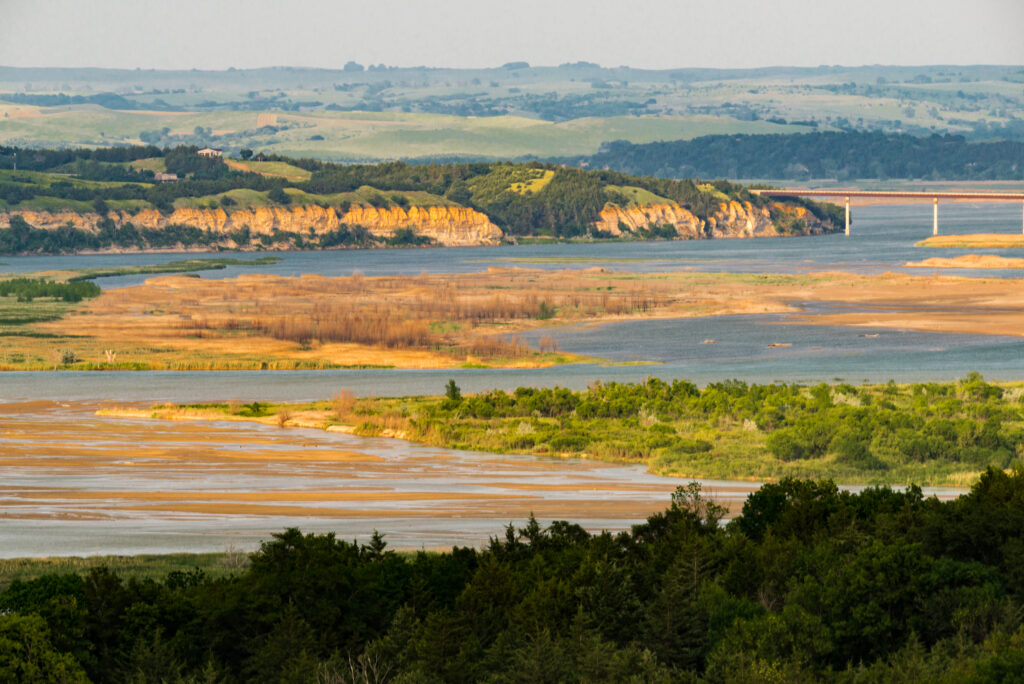
BARBARA FARRAR Well, it seems to me, the river’s big problem is its continued increase in sand. The river needs to be dredged. Something needs to happen; because down the line – down by the dam – it’s filled in with sand.
They must do something. I’ve been to a few meetings about it. It seems it will take another 50 years to happen. But at least, my kids will still be alive.
NWNL They say a dam’s average age is the same as that of an average human.
BARBARA FARRAR When the river first started filling up with sand, I read it would take about 50 years. Well… now it’s been over 50 years.
NWNL Are there plans to address that?
BARBARA FARRAR They have all kinds of studies going on. You know about red tape. My feeling is they don’t ever come out and just say what really happening. They draw it on paper. Many are young engineering graduates from college. They all know what this river does.
NWNL Studies don’t talk and they can hide the numbers. We saw that happen in the Snake River Basin. One member of the Corps of Engineers left the Corps and said, “I brought out with me all the numbers. They’re all wrong – and they support keeping the dams in the Snake River. The dams just keep costing taxpayers money.”
BARBARA FARRAR The dams flooded us in 2011, because they held too much water back in the spring. So there was hardly any water in the river. Then, all of a sudden they had to release the water because there were storms upriver in Montana and North Dakota.
So we had water clear up almost to the school down there. We couldn’t golf. Homes that were upstream along the river were ruined. And, it wasn’t just here. That happened everywhere up and down the Missouri River.
NWNL How far a stretch was the river flooded?
BARBARA FARRAR I suppose it started in Fort Pierre. [Editor’s Note: Fort Pierre Chouteau was a major 19th-century fur-trading post in central South Dakota and a military outpost there on the Missouri River’s west bank. It was a vital hub for trading fur, buffalo robes and pelts.] They flooded the river. Barge traffic was okay, but the river flooded all the way through Nebraska, clear down to Omaha. There the Missouri River is deep and narrower, but still, there was water all over.
NWNL The river here appears to be a braided river – looking like Nebraska’s Platte.
BARBARA FARRAR It’s because of the sand.
NWNL I assume it’s due to the sediment coming out of the Niobrara Delta as well.
BARBARA FARRAR Yes! That’s what they claim.
NWNL They won’t take that dam down, though. Is it sediment that stops boats coming further upstream?
BARBARA FARRAR Yes. Barges and commercial motorized boats are legally banned and don’t go up the Niobrara at all, since the river is so shallow.
NWNL That’s what I figured. Just canoes, kayaks and inflatables go on the Niobrara, I assume, since Yankton and Fort Randall are both historic points along that stretch – designated as a Missouri National Recreational River.
BARBARA FARRAR Those boat trips up there take about 3 hours and offer good time.
NWNL How do you assess the importance of the Missouri River, compared to the Niobrara River?
BARBARA FARRAR Its recreational value is very important economically, due to its hunters, fishermen, and summer recreation people who come.
NWNL Going a bit beyond your territory and west of here, I’ll cover towns on this trip that sit atop the proposed Keystone XL Pipeline. It will not cross your back yard; but do you have any opinions on the XL Pipeline? I hear pros – and cons, so I’m trying to get a sense of what Nebraskans think.
BARBARA FARRAR They’ll get that pipeline through, no matter what. But they must protect the Ogallala Aquifer. I believe those pipelines will leak – no matter what anyone says!
NWNL I understand. I have a list of pros and cons – 2 or 3 pros and 13 cons!
BARBARA FARRAR No employment will come of it.
NWNL There will be 4 months of construction. After the trench is filled, there’ll only be 18 people employed in Nebraska. That’s very minimal employment.
BARBARA FARRAR Very.
NWNL It seems TransCanada will be taxed for land they take over, which could significantly help local schools. Does that mitigate your thoughts on the Keystone XL Pipeline?
BARBARA FARRAR I really don’t have any opinion on that since I haven’t studied it. I just know what I hear.
NWNL Do you have any sense of the quality of schools in the state?
BARBARA FARRAR I think they’re pretty good. Having taught here, my opinion is probably biased. On the Alumni Board, and we interview seniors from this school, I’m so impressed every year with the kind of kids that come out of the school here. But we don’t have many who stay here, since most go on to college, graduate and settle elsewhere.
NWNL You live in a town where two important rivers come together, creating wetlands that add to the history and lore of the Missouri River Basin. Does that interest or impact the children growing up and going to school here? Do you think they will gain a sense of the importance of these rivers and the river systems in their schools?
BARBARA FARRAR I haven’t taught down here; but I see their families using the river for recreation and sports as much as my family does.
NWNL One of the concerns of the Santee Nation is a lot of pollution goes into rivers from cattle and farming, including insecticides and pesticides. There aren’t enough riverine barriers to filter it. Have you heard fplls talk about that?
BARBARA FARRAR Only briefly at a meeting I went to about our rivers and the predictions of how much sand was going to end up at Gavins Point. The sand only stays there briefly. They feel it is mainly because much of the sand erosion was coming from the farms instead of the rivers.
NWNL Who hosted the meeting?
BARBARA FARRAR The US Army Corps of Engineers has hosted several meetings; but I am not sure they hosted that one. But I do know that this one came from the kind of study that was usually done by the government.
NWNL Barbara, thank you for your time and insights. Your Niobrara River has great values and several significant challenges. Thank you for sharing your extensive knowledge on this critical Mississippi River tributary. It was nice to chat with you.
Posted by NWNL on November 06, 2026.
Transcription edited and condensed for clarity by Alison M. Jones.
All images © Alison M. Jones, unless otherwise noted. All rights reserved.