
Interviewee
C. C. Lockwood
Atchafalaya Basin resident, author, photographer
Interviewers
Alison M Jones
NWNL Director and Photographer
Gussie Baker
NWNL Photographer in Nile & Omo River Basins, 2025
Atchafalaya's "Blue Hole" & Bayou Chene, near Baton Rouge LA -- October 23, 2015
Introductory Note
Years before NWNL was launched, I was mesmerized by Gwen Roland’s “Atchafalaya Houseboat” book on her 8 years living on Louisiana’s “Bloody Bayou.” Then I met fellow photographer C.C. Lockwood and studied his gorgeous books on the Atchafalaya Basin’s assets and wildlife found within its 1.4 million acres. It was a thrill to spend time with C.C. in person, amidst the Spanish moss and swamp cedars of those bayous!
Few know more of the natural and cultural histories of this magical corner of the US than C.C. Thus, deservedly, he received the Ansel Adams Award for his extensive body of conservation photography, which has been widely published, including in National Geographic Magazine.
NOTE: C.C.’s photo books in our NWNL Library include:
- Around the Bend. 1998
- The Alligator Book, 2002
- Marsh Mission, 2005
- C.C. Lockwood’s Atchafalaya, 2007

Outline
DISPARATE, YET SIMILAR, ECOSYSTEMS
BAYOU CHENE CULTURE
ALCIDE VERRET’S CAJUN LIFE
A GEOLOGY & CONSERVATION FOCUS
THE POWER of PHOTOGRAPHY
SEEN FROM A BLIND
Key Quote “No matter how far we go out into the marsh, we hear, see and feel the active presence of man, and no matter how close we get to a community lock, shipyard or tug pushing a six-pack of barges, we see and hear wildlife. What I have learned this year is that we are all tangled up in a maze of pipelines, industry and marine commerce that interacts with community, culture, and recreational and tourism.” — C. C. Lockwood, 2005
All images © Alison M. Jones, unless otherwise noted. All rights reserved.
DISPARATE, YET SIMILAR, ECOSYSTEMS
NWNL C.C. , thank you for inviting us into your home. I’ve long wanted to experience the magic of these Louisiana bayous, thanks to the power of your wonderful images. How did you end up here?
C. C. LOCKWOOD Before coming here, I lived in the Rocky Mountains. Then I came here with a camera and took my first look. A photographic book I was involved in had an intriguing chapter on invasive water hyacinth in these bayous. The book had about two pages on the hyacinth. It was almost hilarious. In the 1920’s folks tried putting arsenic on these plants; but that killed two of the workers. They tried dynamite the water hyacinth, but all they did was blow dynamite over the trees into the next bayou. Then they started again. And… the hyacinth are still here!
And you… Have you photographed the Botswana swamps?
NWNL Yes, I documented Botswana before I started No Water No Life; and then I returned a second time. Yesterday, when I was flying low over your bayous in a private plane, I was indeed reminded of Botswana’s varied islands and surrounding water.
C. C. LOCKWOOD I think of that long Okavango River here, especially on days when the water’s up here – and the current’s just flying down, logs are floating everywhere, wind’s up, and waves are pushing the water. The local tribes along Botswana’s Okavango really live off the land – as the locals do here.
BAYOU CHENE CULTURE
NWNL As we drift away from your dock, talk about Bayou Chene’s history.
C. C. LOCKWOOD In its heyday, the Bayou Chene community was thriving up on the banks about a mile down the bayou from here. I think 1,500 people were there in the heyday of their community churches, homes, and gardens. Once a boat came by to sell them groceries and buy fish they had caught. There was a “school boat” that took children here and from other communities to the local school.
In the late 1940’s, I believe, the US Army Corps of Engineers told folks in Bayou Chene that the water was going to start rising, and so they needed to get out. Slowly, folks started moving away. Yet, a few people moved from houses onto houseboats. By the time I started living out here, there was nothing left in Bayou Chene but a few rooftops sticking out of the sediment. Then after the 1973 and 1974 high water, the Bayou Chene community was completely underground.
You can see the resulting camps behind me now. Many of the people who were born and raised out here moved to the edge of the swamp. Some have now come back and built camps. Some of them spend a substantial amount of time here.
NWNL You’ve told me a little bit of what it was like then. You described the firs that grow here and their droppings, and the people building a church first.
C. C. LOCKWOOD Yes, I’ve seen remnants left by many who lived off the land in the Atchafalaya Basin, below Morgan City and over in southwest Louisiana. It’s a shame I didn’t photograph that at that time; but I was then more interested in animals, birds and mammals. I would meet the people; have coffee with them; and then take a picture. So, I have some images from those days; but I certainly wish I had more from those early days.
NWNL What was the original population of Bayou Chene? How did they sustain themselves without a boat? And how did they adapt to living off the land here?
C. C. LOCKWOOD I understand there were about 1,500 people in Bayou Chene’s heyday. There were also a few other communities around the Atchafalaya Basin that totally lived off the land – from their gardens, fishing and trapping. They sold their catch to buy their staples of coffee, sugar and things that they didn’t have out here. It was a simple life; but I understand it was a lot of fun. They would have little “fais-do-do’s” at folks’ homes. They would get together as happy, fun-loving people.
They still have a reunion every year with all their relatives. I went a couple times to their Bayou Chene Reunion. There is one man who makes models of their former school boat and fish boat. They just have a good time!
NWNL What’s a “fais-do- do”?
C. C. LOCKWOOD Basically, it’s just a Cajun dance party with live music of an accordion and a fiddle.
NWNL Ahh! In France, parents say “fais do do” to their children at night imitating the way children say “fais dormir” which means, “go to sleep.” I’ve read that’s what Cajun parents would say to their young children during evening dance parties.
C. C. LOCKWOOD Could be. I studied photography – not French! But it’s a nice sounding word.
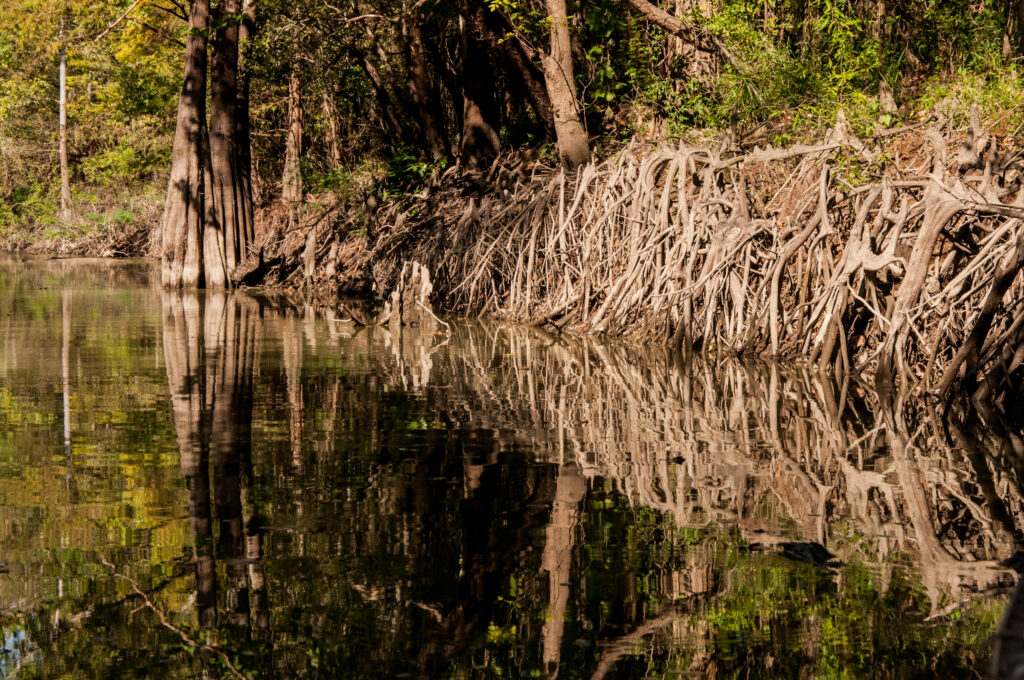
As we move along this bayou, you can see they’re starting to clear out vegetation. It may be interfering with a buried pipeline. I guess they don’t want the roots to break the pipe.
It used to be that you could fill up this bayou any time of the day. Often there would be 5 to 6 boats out there – and 5 or 10 people on the porch drinking coffee, eating pineapple upside-down cake, deer stew, fried catfish or white beans. There was always had enough food to feed an army – and everybody was welcome.
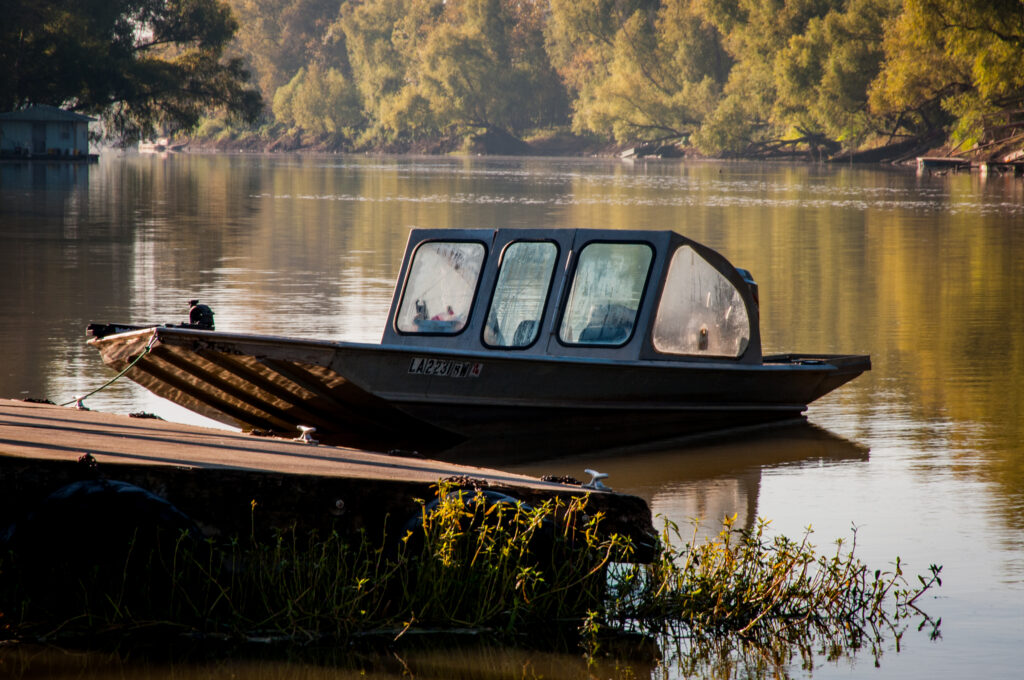
ALCIDE VERRET’S CAJUN LIFE
C. C. LOCKWOOD One friend lived here until about 1996 when he died, at about age 96. He was just the friendliest, hard-working old Cajun man I’ve ever met – a real wonderful person. He finally moved into town and died a few months later. His cabin here is just slowly sinking back into the swamp.
He could tell some tall tales! He said his dog was so tired one day it had to lean up against the fence to bark. He said that one day the bayou was so muddy that you could cut bricks out of it. He had a million tall tales.
NWNL His sayings are in your book. I’ve written down some of them in the front of my journal.
C. C. LOCKWOOD He was neat.
NWNL Didn’t you also write that his peppers were so hot that you just toss them over the pan, rather than put them in and cut them up?
C. C. LOCKWOOD Yeah. One time he had so much parsley, he had to mow it.
His tomatoes and everything he grew was bigger and better than anybody else’s. He had some wild roses that were in bloom when I was out here this May. They’re still blooming all the way down to the water.
His National Geographic Magazines that Calvin and Gwen bought him are still stacked up back in the bedroom, and that’s 15 years of being out here, despite high water, low water, heat, cold.
NWNL Did he live right here all 96 years?
C. C. LOCKWOOD He lived right here about 20, or 25 years. He had lived on the main channel of the Atchafalaya River, but the banks cut it off. And he lost his house just down on the river a mile to the left. He also lived in civilization in one of the little towns nearby for about ten years. But finally, he decided to come back, and he spent the rest of his life here.
A GEOLOGY & CONSERVATION FOCUS
NWNL When did you come to Louisiana?
C. C. LOCKWOOD I grew up in Arkansas and came to LSU [Louisiana State University] when I was 18. I discovered it was a lot more fun than Arkansas – and so I stayed.
NWNL How did you evolve into setting up your Marsh Mission book; and how much did that accomplish, as far as conservation?
C. C. LOCKWOOD Real early in my days in the Atchafalaya Delta, I was working and going out into the bayous with some LSU coastal scientists. They explained how this Atchafalaya Delta was “geology in the making” — and not in millions and millions of years ago, like the Grand Canyon. The Delta was creating land and making new land right then, as we spoke.
Then I heard those scientists talking about how just a little to the east and a little to the west we’re losing land. I think it was 1974 when I first realized that Louisiana’s coast is sinking! I established that as one of my environmental themes for the rest of my career.
When publishing Marsh Mission, I decided I had to do something else – something more. So, we turned our 4-year project living on a houseboat into doing a book, a webpage, art, a tour across the country and a lecture series to bring a little more attention to the disastrous problem here in the Mississippi Delta.
Some people say a football field is being lost every 36 minutes, which totals 24 square miles of land a year. If you add it all up, 5% of Louisiana has already sunk and washed away. If you lost 5% of your retirement account, you’d be mad. Think if you lost 5% of your yard or 5% of your house…. Yet here, all these Louisiana citizens let 5% disappear. It is just amazing.
The good thing is we got the word out. Everybody now realizes what’s happening. The challenge now is how we can get them to do the right thing to correct this problem; how to spend the money in the right way; and how to get the sediment out of the Mississippi River and back into the wetlands. That would allow us to start building up the Delta a little.
NWNL Did your Marsh Mission book result in any specific conservation action? I understand its mission is to raise awareness, like our No Water No Life mission. How have you defined the goal for your book. What do you see that has been accomplished by Marsh Mission?
C. C. LOCKWOOD Well, as I’m not a Colonel in the U. S. Army Corps of Engineers, or the Governor of Louisiana, or the President, or a U.S. Senator. I can’t say, “Take the sediment out of the Mississippi and put it in the marsh.” But we used the book, a lecture series and an exhibit to get the word out. We’ve hoped we could get enough people to convince others with power to do the right thing.
Yearly, something like 77 million cubic yards of sediment is wasted as it flows out from the Mississippi River into the Gulf of Mexico. That sediment could be a great benefit to these marshes! As everybody has learned from Katrina and and similar floods, we really miss that marsh. Now, storm waves come in much stronger.
Southeastern New Orleans used to have 30 more miles of marsh between New Orleans and Bayou Chene than we have now. Those wasted 77 million cubic yards of wasted sediment now gone would have slowed down future hurricane surges. But that sediment is now gone. It sank and subsided away, all within the last millennium. But we always had new sediment replenishing itself each year – it was a natural process.
THE POWER of PHOTOGRAPHY
NWNL How does the power of photography make a difference? It’s what you and I are both doing – using the power of photography to raise awareness of environmental threats and solutions.
C. C. LOCKWOOD My Marsh Mission book has my photographs, but also paintings by artist Rhea Gary. So we thought Marsh Mission, with its two approaches to documenting a vanishing coastline, would bring significant attention to this challenge. Photographs really can show the difference between what was once a beautiful marsh – but is now dangerous open water with lapping waves that destroy the rest of the marsh.
Aerial photography can very effectively show what used to be marsh, but is now open water. It’s a very important tool in documenting current environmental issues, in my opinion. I’ve been using it since the early 1970’s to communicate how valuable the Atchafalaya Basin is and how valuable the coast of Louisiana is. Photographs of fish and wildlife – especially endangered species – are a very powerful tool to introduce many people to the joys of nature – as well as some of the harsh things that are happening to the Atchafalaya Basin..
NWNL Ah! we have come to your favorite photo blind.
C. C. LOCKWOOD My best wildlife experiences usually came from blinds. I set up and use my favorite blinds for two years. They were about 15 feet up in a couple of bald cypress trees near some great egret nests. There were also about ten other species of colonial birds nearby in other nests. It was fascinating. I spent many days there over a two-year period, and not only during nesting season. I could sit in it the rest of the year and sometimes see alligators crawling by, deer walking by, raccoons, plus river otters!
From dawn to dark, it was a fascinating place from which to watch life in the rookery. A red-shouldered hawk would fly in, and 5 or 6 egrets would immediately fly up and meet it. The hawk might have its way with one egret; but when 5 of them came squawking at him, he decided to leave the area. On a few nights, I spent the night in a blind.
One time when the bullfrogs were active, I went to get some night shots of them. I cooked my little supper in a little backpacker stove in the blind; while waiting until it got pitch dark to go down to the water. At the time, as everywhere out here knew, the water varies. But it was a little above the average. Wearing my hip boots and headlamp, I tied the bow rope to my canoe to my back belt loop and
pulled the canoe with my extra lenses behind me.
I wore a headlamp and was slowly trying to creep up on bullfrogs. None of them would stay. I was getting frustrated after about 3 or 4 hours. Finally, a green tree frog called. I was about to reach the perfect distance with my 105-millimeter, macro lens to get the perfect reproduction ratio I wanted. I moved my right foot, and thought I felt a stick that might snap and scare the frog – but it was an alligator! Its tail came up and slapped me across the chest. I fell over backwards; back-pedalled with one hand as fast as I could; and held my camera up with the other hand. My heart was acting like a cartoon character, “Ba-bong, ba-bong, ba-bong!”
I finally realized he was a small alligator, and he was going the opposite way as fast as he could. So, I stood up, emptied the water out of my hip boots, put my cameras in the canoe, and said, “Well, that’s a night!” I turned around and wondered, “Which way is the blind?” In the daytime it’s easy; but at night, all these trees look alike. So, I walked around for another two hours trying to recognize landmarks to get back to my blind. Finally, I got to bed about 4 in the morning! It was an exciting night. I’m glad it happened.
NWNL That is a great story. It was all I could do to keep from laughing, because if I start laughing, my video camera will start shaking.

BECOMING CAJUN ....
NWNL So – last question! You weren’t born here, so you don’t really have Cajun blood. But in your soul, do you feel like a Cajun?
C. C. LOCKWOOD Oh, yeah. On the third week I was here studying at LSU, the people, the food, and just the atmosphere of southern plants before I even saw the swamp hit me. I grew up in the outdoors and had spent all my free time canoeing, camping in the Ozarks and hiking, so it took me a while. When I first started coming into the swamp, I crossed a little bayou and stuck my foot in and stuck it out and stuck it in – like a little dance. I was used to clear water in the Ozark streams, but this was muddy. I finally waded across, and quickly figured out that this is just a beautiful place. The water quality is pretty good due to the filter factor of its going through all the bayou vegetation.
There weren’t that many alligators back then, so it was exciting. Once I had waded across my first bayou, I fit right in. This was my habitat.
NWNL That’s great.
C. C. LOCKWOOD This basin has some scour holes that are 105 or 110 feet deep. It’s remarkable that this basin hasn’t silted up. In the Mississippi River, folks have to do serious dredging maintenance to keep barge traffic floating down to Baton Rouge and ship traffic in Baton Rouge to get out to the Gulf. The Atchafalaya is not consistently 100 feet deep, but it’s quite deep all the way up and down. The sediment comes out of the Atchafalaya down bayous like this one. When the flow slows down, sediment settles out, and the land dries it out substantially throughout the Middle Basin, where we are now.
Some of it makes it down to the Atchafalaya Bay, where we’re getting significant new accretion. It’s trying to help a little – especially critical as the rest of our state is sinking so fast.
NWNL What advice would you give to someone – say, from New York City – coming down to experience the Atchafalaya Basin? How best can they do that?
C. C. LOCKWOOD For me, the answer to just get a canoe with a tent and go camp out a couple of nights. That is the experience to have when you’re out here from dawn to dark, sunrise to sunset, clear and foggy, stars and rain. It’s just a beautiful place and so peaceful. I sleep well at night when out here.
NWNL Do you have a favorite time of year here?
C. C. LOCKWOOD Spring and fall. Spring and fall are great everywhere. The winter, it’s usually that humid cold and a lot of overcast days, so it’s just harder to enjoy weather-wise.
But spring and fall is a great time in Louisiana, probably slightly fewer mosquitos and cooler weather. As a photographer, the sun’s angle in spring and fall is a little lower, so you could work more hours during the day. It’s kind of cliché, I guess, because spring and fall is good in most places.
NWNL C.C., thank you for sharing your Cajun time and background with us. May stewardship here increasingly protect all this beauty and support stronger flood resistance. Meanwhile, keep sharing your photographs to raise more awareness and conservation interest!
Posted by NWNL on October 19, 2026.
Transcription edited and condensed for clarity by Alison M. Jones.
All images © Alison M. Jones, unless otherwise noted. All rights reserved.